
How much energy is lost due to dirty panels ?
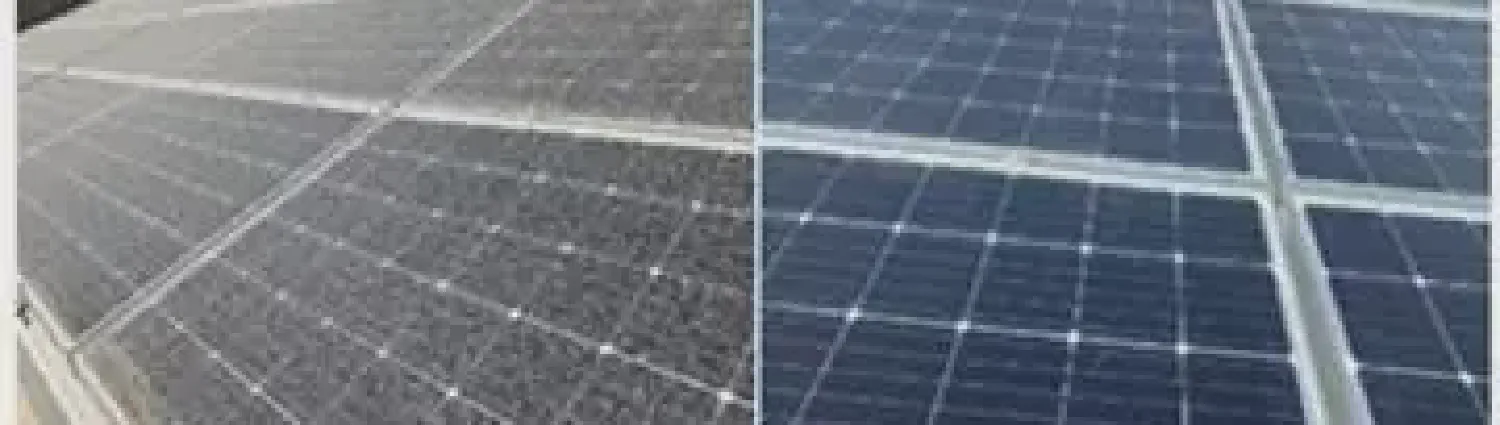
This article delves into the reasoning behind the image below:

We wanted to give a quantitative estimate of how much energy you are losing by cleaning your photovoltaic (PV) panels not often enough. The estimate needs to take into account the most important parameters and serves the purpose of computing an order of magnitude of the energy lost due to dirty panels.
The lack of understanding of the PV cleaning is that dirt accumulates over time depending on weather conditions and can lead to significant losses in the portion of energy produced. For example, here is air pollution levels (CAQI) and rain precipitation (mm water) of a big city.

The study of how dirt accumulates on PV panels is still an active area of research and has become a complex topic to understand. To date, evidence from scientific literature has demonstrated that rain, wind, and smog have a significant impact on the performance of PV production.
The next figure shows the cumulative fraction of energy lost over time in the past year in Johannesburg, South Africa. The graph can be read as follows:
-
the left y-axis measures the cumulative share of energy lost relative to the energy produced. For example, 10 % on the left y-axis means that you produced 100% -10% = 90% of the energy with respect to peak performance.
-
the right y-axis quantifies the daily efficiency loss of the PV panels, relative to their peak efficiency. For example, reading 2% on the right y-axis means that your panels are operating at 2% less efficiency relative to their peak efficiency.

Overall, the figure suggests that, in this particular geographical location, due to the level of air pollution and the amount of rainfall, the accumulation of dirt on PV panels could have resulted in a 10% yearly loss in energy production compared to clean panels.
Remarkably, the size of the PV array and its age do not affect the plots above. This is because these figures only show ratios and proportions. It is possible to run the energy loss model in different locations by considering different PV array sizes and ages, to calculate an absolute energy loss in kilowatt-hours.